
fruit notes
It’s January, it’s a new year, and I haven’t had an avocado in months. We’re lucky that we basically SWIM in Hass avocados for many months of the year, grown by Condor Ridge Ranch in lovely Goleta. We eat so many delicious avocados between February and August that it somehow holds us over through fall and winter, until California-grown avos are back again. I’m spoiled, what can I say! And yet it has been a long avocado winter, so believe my excitement when I write that we’re about a month out from Hass avocados being officially creamy enough to start harvesting in California. I can’t wait!!
While Hass avocados are the primary variety grown in California – and for good reason, they are SO good!! – we like to bring in other varieties so we (and you!) can taste everything available. January means the early avocados have started in Southern California. Walk through a farmers market and you may be lucky to find green-skinned avocados dotted amongst the sea of bright orange, pink, and yellow citrus. The ‘Bacon’ avocado is the most well-known green-skinned variety, its fame no doubt boosted by its marketable name. Similar to the Bacon, and in the boxes this week, are Zutano avocados. Zutanos mature early in the season and have a thin, green skin that stays green even when they have become ripe.
It makes sense that many of these early green-skin varieties aren’t favored commercially. Zutanos’ super-duper thin skin lends itself to bruising during transport. Maybe more importantly, they don’t change color when they ripen, eliminating the visual cues that avocado eaters are accustomed to. They also have a very short harvest window—likely just 2-3 months—before the bottom of the fruit tends to develop a brown discoloration on the tree. And just as we associate green with unripe, we tend to associate brown with spoilage, even if the mark is only skin-deep. But we love giving these lesser-known varieties a chance, even if they’re not quite as creamy and nutty as a Hass.
Zutanos were first cultivated in Fallbrook in 1926 by a nurseryman named R.L. Ruitt, making them one of the oldest commercial avocado varieties in California. It feels especially fitting that this week’s avocados are lovingly grown in Fallbrook by Garcia Organic Farm, on their sloping terrain of avocados, citrus, and subtropicals. Let them sit on the counter at room temp for 2-4 days until they soften slightly, with a little give at the neck. Grown organically by Garcia Organic Farm in Fallbrook.
Nick the end of the Ice Cream Bean where the stem was attached and peel away a strip of the leathery skin, like you’re unzipping a zipper, to get into the custardy, vanilla-y flesh! The good stuff is the white fruit that’s wrapped around a big black seed. The seeds are inedible. They are ready to eat now, or will keep in the fridge for a few days. Grown organically by Condor Ridge Ranch in Goleta.
Though John Lagier has transitioned his farm to new ownership, he can’t bear to see all those beautiful Page mandarinshanging on the trees and falling to the ground. Lucky for us, in collaboration with the new owner, we’ve gotten many more surprise harvests beyond what we anticipated! Every week, they keep getting a little sweeter too. Keep on the counter. Grown organically by the farm FKA Lagier Ranches in Escalon.
We still haven’t gotten over how challenging this Satsuma season was for most farmers in California given the weather in December. So we’re hanging onto the ripest Satsuma mandarins we could find. Super sweet, easy to peel, pushing-the-boundaries-of-ripeness satsumas from SoCal. Recommended to eat now 🙂 Grown organically by Garcia Organic Farm in Fallbrook.
Sanguinelli blood oranges are a treat with a nice balance of berry-like tartness! The flesh of blood oranges continue to deepen in color with more cooler nights this winter. Sanguinelli will never be quite as bloody as a Moro, but imo the flavor is superior! Ready to eat now or keep them on your counter. Grown organically by Murray Family Farms in Bakersfield.
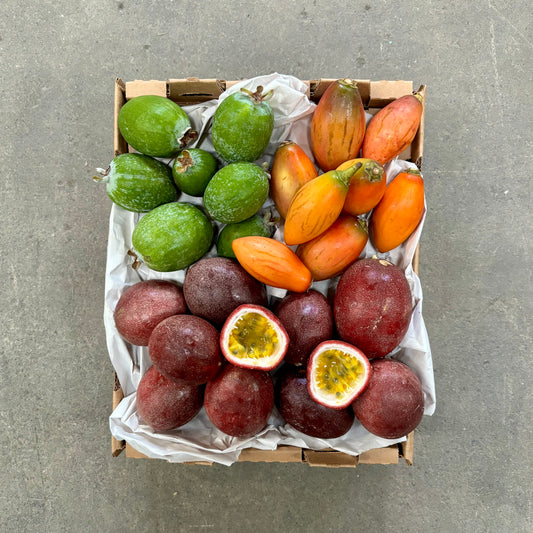
Beaumont Mexican guava is cute and pear-shaped and can be eaten tart and crunchy like an apple while green or left to ripen on the counter for 2-3 days until it lightens in color and softens a bit. You should be able to smell the tropical scent as it ripens. Like with a lot of a tropical fruit, the uglier the skin gets the tastier it’ll be. Keep on your counter. Grown organically by Garcia Organic Farm in Fallbrook.
Rainwater Washington Navel oranges just keep getting sweeter and tastier with all this sunshine! These are ready to eat, and we like our oranges at room temp so we keep them on the counter. But if you want to extend the life of them, keep them in your fridge. Grown organically by Rainwater Ranch in Winters.
This is the last hurrah of John Lagier’s beautiful Chandler pomelos. Peel away the thick rind and membrane from each segment and eat just the juicy pink flesh. We’re a few weeks away from the start of Lunar New Year (February 17th this year!) so we’re enjoying these pomelos before refreshing our citrus shrine in the next couple of weeks to celebrate the new year. Keep on the counter. Grown organically by the farm FKA Lagier Ranches in Escalon.